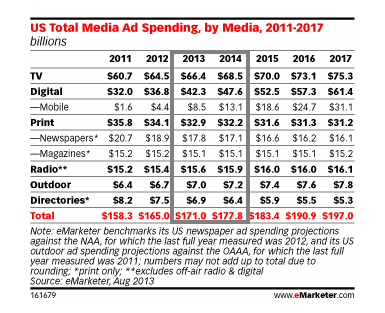
 A good thing… marketing budgets are going up. Highlights:
TV remains king.
Digital growing by more than $5 billion per year.
Mobile expected to grow by $22.6 billion in next 4 years.
And, surprisingly, print holds steady.

Peter Levitan & Co.
The New Business of Advertising
A good thing… marketing budgets are going up. Highlights:
TV remains king.
Digital growing by more than $5 billion per year.
Mobile expected to grow by $22.6 billion in next 4 years.
And, surprisingly, print holds steady.
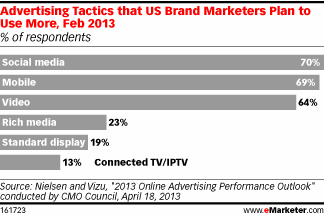 From the land of “you know” this, comes a reinforcing eMarketer article and graphic showing you where the marketing / advertising budgets are going and you know what’s coming… I say follow the money.
Wow, so many opportunities for your agency to: build out social media, mobile and video expertise; so many opportunities to recalibrate your brand positioning and sales proposition. So, are you? I got to go WTF if you aren’t.
… And One To Help Go Get That Car
As an addendum to my Advertising Week Social Club “Dreaming of a Car Account?” interview with Nielsen’s Ian Beavis, I offer some more thoughts on why you should go after a car account.
Not that you didn’t know this but these guys spend big bucks. According to Kantar Media, in 2013’s first quarter alone, automotive manufacturers spent $1,971 billion and $1,381 billion respectively on manufacturer and dealer advertising.
According to Ad Age, General Motors spent $3.59 billion on advertising last year while Toyota spent $2.86. For contrast, Hyundai and Kia spent only $776 million and $1.26 billion.
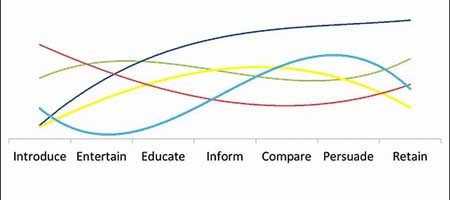
Again, no surprise that auto accounts use all types of media, which offers agencies of all stripes the opportunity to customize services for manufacturers and dealers. According to Ads24’s most recent Path to Persuasion (P2P) Wave 4: Automotive (passenger cars), “Usually, the most effective media mixes include media formats that play differentiated roles across the Path to Persuasion.”
Just as a reminder… Has anyone not seen Audi’s “Prom”?
https://www.youtube.com/watch?v=ANhmS6QLd5Q
Or, Volkswagen’s “The Force” (with 58 million YouTube views)?
https://www.youtube.com/watch?v=R55e-uHQna0
Or, Kia’s “Hamster Rap”?
Or… Chrysler and Eminem?
https://www.youtube.com/watch?v=SKL254Y_jtc
Toyota has been with Saatchi & Saatchi (nee Dancer, Fitzgerald, Sample) since 1975. Car accounts are hard to move.
“A car account always has been a rite of passage in the world of agencies,” said Jon Bond, co-chairman of Kirshenbaum Bond Senecal & Partners. “It’s like being a made man in the Mafia, but … today, you can get whacked the next week.”
Two of the more interesting questions and answers from my interview with Ian Beavis, EVP Automotive at Nielsen and ex auto CMO point to the fact that agencies can find a wedge service into auto accounts. Go for it boys.
Levitan: A final question. Agencies have a hard time creating a competitive agency brand positioning. Any insights and advice you can give to the agency world on how to be distinctive in this highly competitive category?
Beavis: You rarely hear of an agency being a business solution provider, as it just doesn’t sound cool or creative. A good agency solves a client’s business issues and is a partner. Very few qualify and even fewer truly embrace this challenge.
Levitan: What are the current digital hot buttons at car companies?
Beavis: Quality lead generation and follow up. It is the top priority with all OEMs
So, be smart, be distinctive, be a problem solver… get going.
I am talking with one of my clients about an agency positioning that positions them as an expert on emotional marketing. As in, the agency is an expert at triggering an emotional response in the consumer. Yes, they have the right chops for this. And, they live in the right country. And, clients, well some, Ok some, understand the emotional vs. the uber rational sell. Kiss me and I’m all yours.
As such, I am sensitized to emotional pitches these days. Here are two examples of emotional marketing in action. One is a movie trailer (from the great Spike Jonze) and the other a Google Nexus website and really sweet video (a really sweet story.)
Why is Google’s advertising getting so much better than Apple’s?
https://www.youtube.com/watch?v=rS8zOLOcPMQ
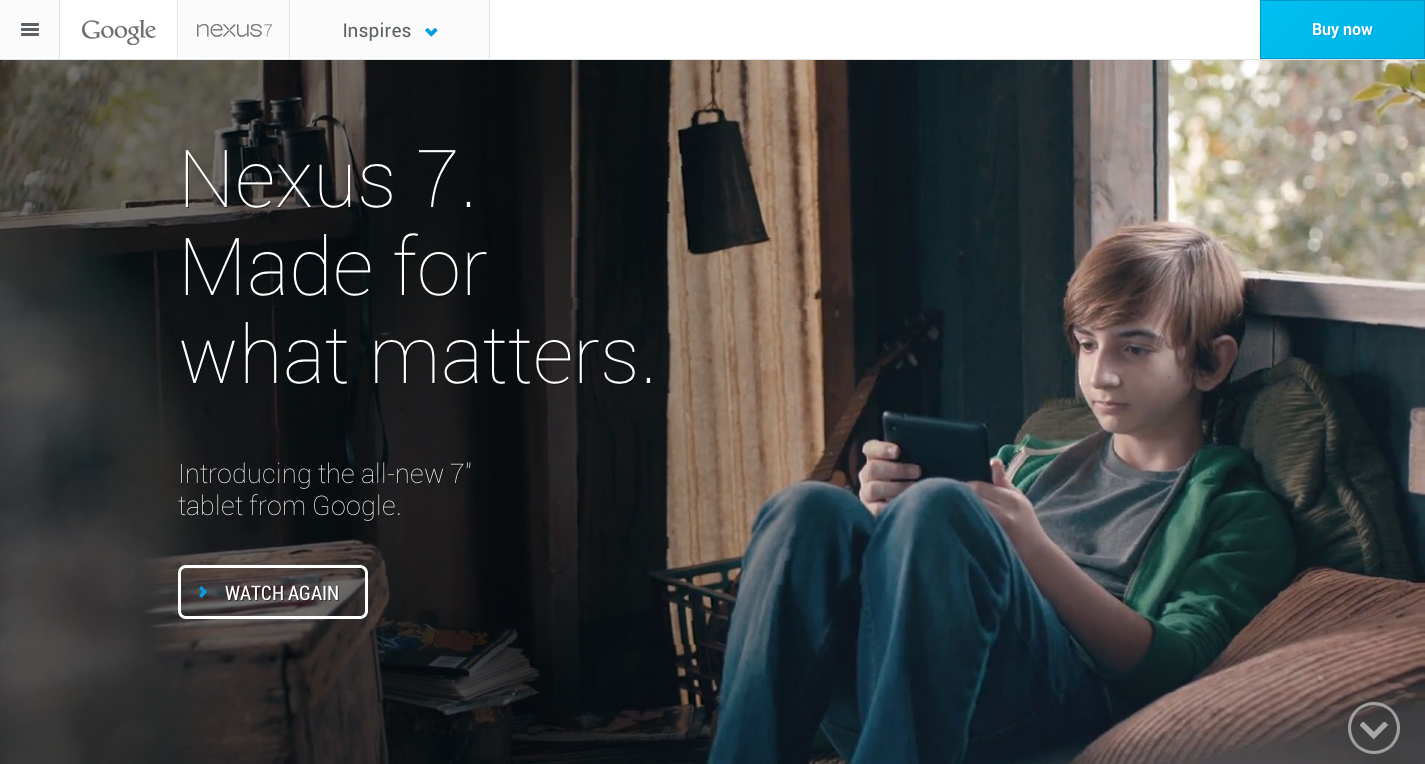
Here is the Nexus website. Watch the video.
I did some personal math the other day. I’ve been positioning agency’s for over 25 years. I’ve got another 13 really smart positionings up my sleeve. If you are interested in separating your agency from the pack, start here…
I worked in the newspaper industry for five years from 1995 to 2000. I started the online newspaper New Jersey Online for Advance Internet which went on to use our blueprint to build an additional 10 online entities across the U.S. (Note, I am not responsible for the design of the current website.)
I was hired by Jeff Jarvis who knows more about the business of newspapers and online newspapers that anyone in the industry. So, when I heard about Jeff Bezos buying the Washington Post, I immediately headed over to Jeff’s well-read blog, “Buzz Machine.” While Jeff hasn’t really weighed in in-depth yet, he will and I am going to follow his evolving views on this purchase. As you can see from his “Hot Off The Presses” blog post, he is “hopeful.” I am too. As an early internet publisher, I watched Bezos build Amazon starting in 1995. It was a very exciting time to watch this visionary.
I think that newspapers which have been run by ossified old white men who couldn’t get out of the way of Craigslist and all the other revenue killers, can now sit on the sidelines and watch a real leader move paper-based and online newspapers to the next level.
I think that paper newspapers will be around for the next few years (my bet not much more than an additional ten.) They will continue to play a big role in our local news ecosystem as they have always provided a powerful daily platform for local advertising which online advertising hasn’t yet replaced. Many have pointed out that the Amazon machine has hastened the demise of the local retailer. That may be true. But, local retail has also been hurt by the slow death of local advertising options. Bezos may just be the guy to reverse that trend.
For another take on the Post, head over to Jason Calacanis’ piece, “Why Jeff Bezos Bought The Washing Post Six-Theories.” .