• Skip to primary navigation
  • Skip to main content
  • Skip to primary sidebar
Peter Levitan & Co.

Peter Levitan & Co.

The New Business of Advertising

  • Contact
  • Blog
  • Podcast
  • My Story
  • Resources
  • Show Search
Hide Search

Insights

Go To Insight Toolkit… Now!

Peter · August 2, 2026 ·

The Levitan Insight Toolkit

New strategic tools I check out every month. Here’s what I actually reach for.

I’ve been using, building, and sharing how to be an insight genius for years. Here is the latest.

  1. Google Trends. You probably know it. Still the fastest read on what’s hot and what’s not in Google’s search universe. Please use this for marketing. Search it!
  2. Think with Google. A free repository of Google’s own data and research. They know things.
  3. Google Alerts. Keep up with news on a client or a category while you sleep.
  4. Google Keyword Planner. Yes, more Google. It draws on historical search data to estimate what a set of keywords might do for your spend.
  5. AnswerThePublic. A visual listening tool that shows you the actual questions your consumers are typing into Google. Add this to Google Trends.
  6. Exploding Topics. Exactly what it sounds like…. a way to spot the next big thing before your competitor does.
  7. Quora. Where people ask what they actually want to know. All answers, no filter.
  8. Pew Research Center. How Americans(and globals) live, think, and vote — nonpartisan and rigorous. I am using it massively for my next 60+ book.
  9. Statista. Statistics and market research data. The paywall is real, but the free previews often answer the question.
  10. vidIQ. Got a YouTube channel? It helps creators find the topics and keywords worth chasing.
  11. F5Bot. Ever wonder what the world is saying about you or your company? F5Bot emails you the second your name hits Reddit or Hacker News… where people say what they think, not what they’ll say to your face. Free. (This slot used to belong to Social Mention. It died. This is better.)
  12. BuzzSumo. Indexes billions of articles. Type a keyword, see what got shared and what got ignored. The internet’s applause meter.
  13. Brandwatch. Qualitative social listening: not how many times a keyword appeared, but what people think and why. (Remesh is the newer play if you want AI-moderated focus groups at scale.)
  14. SurveyMonkey and Typeform. Collect your very own market research data. Clients dig polls YES!!!! Even man-on-the-street interviews.
  15. Ubersuggest. Neil Patel’s tool for competitive keywords and search trends. Treat it as a paid tool that occasionally lets you in for free.
  16. Add filetype:pdf to any Google search. You’ll skip the blog slop and land on the higher-level thinking: academic papers, real reports, actual rigor. A technique, not a product, which means it’ll still work when every tool on this list is dead.
  17. Gartner. Insights and reports. Expensive, corporate, and right often enough to matter. But this instead of the expensive dinner you will forget..
  18. AI research assistants — ChatGPT, Claude, Gemini, Perplexity. The twenty hours of desk research that used to bill out now takes an afternoon. Use Perplexity when you need sources you can cite; use the others to pressure-test a strategy at 11 p.m. when your planners are asleep. They don’t replace the judgment. They kill the grunt work. You know this. So, just saying.

GO!


WOW! Business Development Via AI

Peter · July 29, 2026 ·

Great Business Development Email.

I got this very personal incoming business development email yesterday. My first reaction was, WOW, gee, someone put in the time to get my attention by getting very personal. Then I thought, wait a minute, this could have been written by AI.

I got less naive fast.

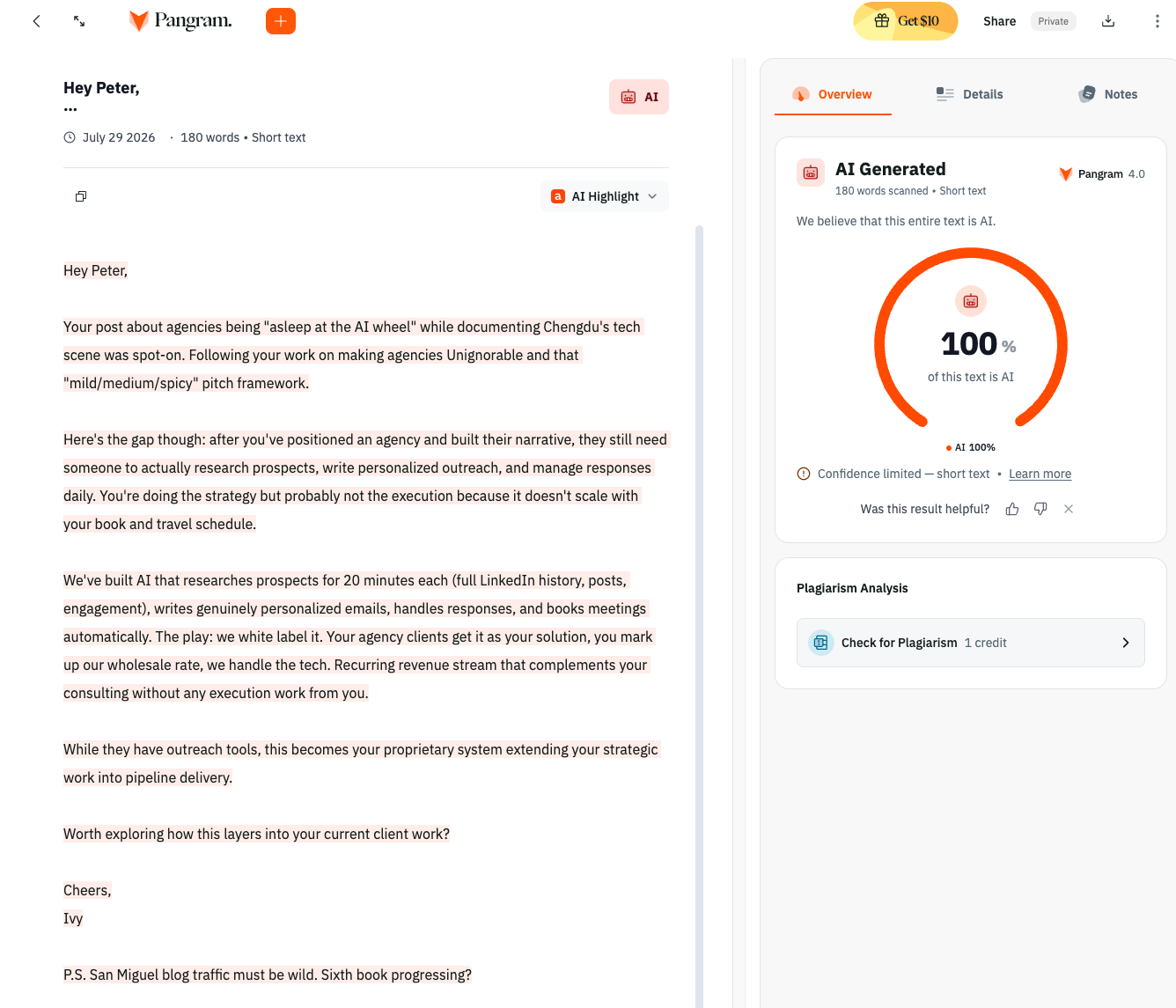
Here is the email:

Hey Peter,

Your post about agencies being “asleep at the AI wheel” while documenting Chengdu’s tech scene was spot-on. Following your work on making agencies Unignorable and that “mild/medium/spicy” pitch framework.

Here’s the gap though: after you’ve positioned an agency and built their narrative, they still need someone to actually research prospects, write personalized outreach, and manage responses daily. You’re doing the strategy but probably not the execution because it doesn’t scale with your book and travel schedule.

We’ve built AI that researches prospects for 20 minutes each (full LinkedIn history, posts, engagement), writes genuinely personalized emails, handles responses, and books meetings automatically. The play: we white label it. Your agency clients get it as your solution, you mark up our wholesale rate, we handle the tech. Recurring revenue stream that complements your consulting without any execution work from you.

While they have outreach tools, this becomes your proprietary system extending your strategic work into pipeline delivery.

Worth exploring how this layers into your current client work?

Cheers,
Ivy

P.S. San Miguel blog traffic must be wild. Sixth book progressing?

Guess what?

Yup, I dug that Ivy referenced a past blog post, that I was in Chengdu, China, that one of my mantras is that people and brands must be UNIGNORABLE, and that I’ve used a “mild/medium/spicy” new biz pitch framework.

But, But.

According to Pangram, the best AI detector, the email was written by AI.

Things like business development outreach are getting interesting. I was naive for a minute. Are you?

Why You Should Write Your Marketing Book – With Andy Crestodina

Peter · February 25, 2026 ·


An Interview With Andy Crestodina…

I wrote my second marketing book, How To Build A Kick-Ass Advertising Agency in 2023. It drove my consultancy. I included one expert interview.

I am posting this evergreen interview with Andy Crestodina for three reasons.

One, it remains a highly relevant interview. Do what he says.

Two, Andy continues to be one of the smartest and most prolific marketing content thinkers and publishers. Learn from him. By the way, he has 132,000 LinkedIn Followers.

Three. I am writing my fourth book and know that books still make sense. This time, it is about everything a Baby Boomer (75,000,000 of them) needs to know about their end game (I also think of it as an exit plan). Lots of well-researched advice, delivered fast. Especially a fast, to-the-point strike-zone read for the ADD generation.

Below are some Andy thoughts on the value of writing your own book (not a 100% ChatGPT book).

Valuable insights from Andy, even in this uber-digital year.

Andy.

Andy Crestodina is CMO and Co-Founder of Orbit Media, an award-winning 55-person digital agency. He has 24 years of experience in analytics, SEO, content strategy and visitor psychology …and 2.4 years of experience in AI. Andy has applied his expertise in SEO and conversions to drive both visibility and lead generation for 1000+ businesses since 2001.

Here is the 7th edition of Andy’s book: Content Chemistry, 7th Edition:: The Illustrated Handbook for Content Marketing (A Practical Guide to Digital Marketing Strategy, SEO, AI, Social Media, Email Marketing, & Analytics)

The Interview.

Peter: There are so many advertising, digital, and content development agencies. How do you use your book to stand out?

Andy: A way to differentiate is by being the most helpful, informative, generous brand. When I started publishing blog posts 15 years ago, I quickly figured out that the lifespan of a blog post is short, that the value you’re putting out in the world is not very durable, and that I could get greater value from this work I was putting in if I was more strategic about it and applied more forethought. So early on, I put out this hypothesis: If you think ahead and write an outline of everything you know on a topic and then blog into those topics, write articles about each of those subtopics, then you will end up with having not just a list of topics and a bunch of articles, but you’ll have a table of contents and a half-written book.

It’s partly differentiation. It’s partly a sales tool because we send it to prospects, and it makes us look and feel different. So strategically, it’s a good strategy because it’s efficient, and it solves a problem, and it supports the bottom of the funnel. It supports sales. That’s basically it.

Peter: I agree that books create differentiation. What other advantages do you get from the printed word?

Andy: In the digital world there’s a Back button in front of the reader. A book delivers more of a captive audience. If you can hook them and get them into a printed book, they’re reserving more of their time and attention for you than in other formats. There are no notifications, there’s no distractions. This book doesn’t do anything else. And the fact that it’s so visual means that we stopped making an electronic version of it. It’s print only. So, I’m really looking for that quality time with the reader, for the chance at better attention and intimacy.

Peter: How does the book work into your overall marketing program?

Andy: The book supports sales goals. And prospects are the ultimate target audience. They’re the most important target audience. But it also supports marketing goals. It leads to lots of speaking engagements, it leads to conversations like this one, it leads to interviews on podcasts, and it creates a lot of exposure.

Books are a differentiated format. Anyone can write a blog post, hit publish, and it goes live. But there’s only a smaller percentage of those of us that are willing to take the time, like you’re doing, invest all of that research and writing into something bigger.

Peter: How do you promote the book?

Andy: The book is sent directly to prospects after meetings. So that’s the number one way it gets promoted. The book also is promoted on our website and has been a popular textbook at universities. The book is in my introduction when I give presentations. We do at least one or two webinars a week. This morning, I was interviewed for a podcast. I was asked, “How can people find you?” I say orbit media.com, and I’ve put all my best into one book called Content Chemistry. You can find it anywhere. It ends up in my introductions, in my interviews,

amplified through all of my normal activity. So, what you just heard was, there’s not a specific marketing strategy to promote the book, but we get more value out of all of our visibility because the book is included in everything we do.

Peter: What are your thoughts about being a guest on other people’s shows—podcasts, for example—versus doing your own?

Andy: Anybody can have a podcast. I’ve done that as a data-driven marketer. It’s a black hole. There’s so little data and feedback you get on podcasts. There aren’t good reports for it. It’s just an act of faith. Even if you’re very, very efficient with the production, it’s frustrating to know what it’s doing for you.

You rely on anecdotes. Oh, I heard you on that thing. So, my podcast strategy is to be part of other people’s shows.

My blog post strategy is very similar. Early-stage content marketers two-thirds of their content should be on other people’s websites. Write for everybody. Write all over the place. I will never stop guest blogging.

It’s been part of my strategy for 10 years.


I Was Fired – A Lot – A ‘Happy Ending’ Story

Peter · February 12, 2026 ·

New York Times Cover


“You’re… Fired”: My Life Story

I was fired five times. Five. Good news, each “you’re fired” led to personal success.

Before I get into my personal story, I want to make it clear that my definition of being fired is not necessarily the usual one. Traditionally, being fired means that you’ve been axed, sacked, canned, let go, terminated, or dismissed. In most cases, people get fired for poor performance, misconduct, breaking company rules, or other issues related to their work or behavior (plus the lovely phrase: downsized often due to a corporate reorganization).

To be very au current, given today’s evolving work universe, someone might have been AI’d. To be more direct, let’s just call it what it is… many careers are about to be brutally fucked by Artificial Intelligence. Not yet rampant. Stay tuned, as some bigly disruption is coming fast.

My firings were never due to poor performance (well, my Adidas case might be an exception). Stay tuned for that intriguing story.

Firing has gone in two directions. In my management career, I unfortunately had to fire people. In every case, letting someone go was extremely painful and upsetting for everyone involved.

Because the act was so painful for me, I have been fascinated (and repulsed) that the term “You’re fired” became part of our vernacular and was even applauded by fans of Donald Trump’s TV show The Apprentice.

This humiliating public dismissal became a bedrock vibe that helped elevate Trump’s popularity and belief in his business acumen. It proved to the unwashed just what a great businessman he has been. Americans have an interesting take on what makes a boss great. They also seem to love Trump’s use of gold…. Everywhere.

1. Fired Number One: Northwest.

I started my advertising career in 1980 at Dancer Fitzgerald Sample, New York’s largest advertising agency. We had multiple floors in the iconic Chrysler Building. DFS’s clients included major brands like Toyota, P&G, General Mills, RJR Nabisco, HP, and Wendy’s.

Not a bad place to launch a career. The 1980s advertising world rocked. My own clients included General Mills (cereals and Yoplait Yogurt), Sara Lee, and Western Union (yes, Western Union, its EasyLink service, get this, was the first commercial email app). Since the term email had yet to exist, as brilliant marketers, we called the benefit “Instant Mail.”

In my third year at DFS, I was asked to run the Minneapolis-based Northwest Airlines account. At the time, the third largest U.S. airline. Not just run the account; I was asked to move to Minneapolis and become the GM of our new office dedicated to this $60,000,000 advertising account. It was a rather good career move as it allowed me to move past my tier of account execs.

DFS inherited the business because our client, Republic Airlines, had been purchased by Northwest, and, well, good news, Northwest liked our style vs. Republic’s existing advertising agency.

Northwest bought Republic to build out its domestic routes. At that time, Northwest, then known as Northwest Orient Airways, was best known for its international service, particularly its leadership in North America-Asia routes. The airline’s “Great Circle Route,” developed in the 1930s, carried more flights to Asia than any other airline.

Back in the 1980s, Northwest was not considered a quality product. The planes were old. The seats were worn. The in-flight service kinda sucked.

To get ahead of the airline’s service failures, we brought in innovative marketing. We launched the most lucrative frequent flier program. We gave away more miles and therefore trips than any other airline. The airline’s largess worked at a time when domestic and global business travel was starting to boom. Good timing.

On the positive side, Northwest was the U.S. to Asia leader in terms of the number of westbound flights. The airline flew to China, Guam, Hong Kong, Japan, Korea, the Philippines, and Thailand. Unfortunately, the international product was uncompetitive and increasingly at risk due to superior service from leading Asian carriers. Northwest was like a Volkswagen compared to a Ferrari. The airline’s dominance was also at risk from United Airlines, which was introducing new Asia routes.

To save the international business, we turned to what I called ‘information as a service’. An uncommon brand attribute in the 1980s.

Our Asia Series was designed to help newbie American businesspeople learn how to conduct business across unfamiliar Asian cultures. Examples: we taught Americans how and when to bow in Japan, how to deliver the right gifts in China, and how to survive a karaoke night in Seoul. These business tips were delivered via a series of TV commercials, 90-second radio infomercials, booklets, and even 900 numbers (yes, those were mostly porn in those days).

The Asia Series was so successful that we won a bunch of creative accolades and prestigious EFFIE Awards for the client and agency. EFFIEs were awarded by the American Marketing Association in recognition of marketing excellence and proven results.

Back to getting fired. [Read more…] about I Was Fired – A Lot – A ‘Happy Ending’ Story

How To Lie: From TV to LinkedIn

Peter · October 19, 2025 ·

To Tell the Truth — Even Better… How To Lie

_____________________________________________________________

The Set Up

What you are about to read is a mélange of life experiences. These include growing up in Manhattan, getting loaded in Puerto Vallarta, being an LSD expert, killing it on a TV show, a bit of HDHD, getting tossed out of college, finding “art,” and getting banned from LinkedIn.

Chapter 1

To tell you my very own truth, I’m a skilled liar. Not psychotic. Just good at factoid manipulation.

I can prove it. Stay tuned.

I grew up on the Upper West Side of Manhattan, across the street from Central Park. When people I meet ask me where I’m from… I say Manhattan. After a few minutes of conversation, they say, “Oh, yeah, I get it.”

I went to McBurney School, a private high school in New York City. It was small – we had 61 students in our senior class. We wore blue blazers with McBurney emblems, gray wool pants, and striped ties. The school was on 63rd Street, sandwiched between Central Park and Lincoln Center. We had what I’d call a classical education. Despite being a smart guy in a smart school, I was not remotely interested in most of my classes, especially math. I was one of those kids who did not meet their “potential”. Frankly, school bored me. But I hung in.

One sunny fall afternoon, I was going to hang out with my good friend Jeff. After classes, he showed up in the school lobby to tell me that he couldn’t do the hangout because our headmaster had asked him to join a couple of other boys, uber math and science lovers, to go down to the TV production company Goodson-Todman Productions. Goodson-Todman was the leading game show company and ran hugely popular TV shows like Family Feud, The Price Is Right, and Concentration. Their office was on a high floor in Park Avenue’s iconic ultra-modern Seagram’s Building.

My classmates were going to audition for two guest slots on the popular afternoon panel show To Tell the Truth. I tagged along… the plan was to run around the city after they finished their audition.

Just in case you are not a baby boomer, To Tell the Truth was a staple of daytime TV from 1956 to 1978. The show was a fun game show where celebrity panelists tried to figure out which of three contestants was telling the truth about having a weird job or crazy experience. The other two were impostors who got to lie through their teeth.

Back to me. Here we are, three blazer-clad high school boys in the Seagram building on Park Avenue, sitting in a very snazzy reception area. Within a few minutes, a young production assistant came out and welcomed us. She asked if we were the boys from McBurney. My buddies stood up, and the woman asked why I was sitting. I told her that I was there as a friend. She said, hey, why not get interviewed too – you are already here. My buddies looked at me with surprise. I’m like, why the hell not?

The assistant took me into a small conference room and started with questions to get to know me. I happily told her that I truly loved math and science (LOL), and I demonstrated that I could put sentences together. Plus, I was telegenic with a workable and effective blush.

It was then that I found out that we were being interviewed for a To Tell The Truth episode about LSD, a drug just then making the rounds of my generation. One of us was going to be one of two non-truth impostor boys sitting beside a Midwest teenager who had won the National Science Award for reporting the effects of LSD on spiders – a 1948 experiment he had recently updated.

I’m like, LSD and arachnids. That’s cool… fits neatly into the zeitgeist. This was 1968, hippies were all over the TV news, and I had read a bit about two newly famous Harvard professors who had experimented with LSD and were becoming 1960s cultural icons.

A day after the interview, our headmaster asked me to come to his office, a rare event, and asked what the heck I was doing at the production company because he was rather surprised to hear that I had been selected to be on the show. I just smiled and shrugged.

I had a couple of phone conversations with the production assistant and was given a date for the show and a bit more detail on the science project. Guess what! The spiders wove crazy webs under the influence of LSD. Who knew?

An LSD Education…

I had two compelling incentives to be a brilliant faker on To Tell the Truth. One was simply my competitive nature. Like, why couldn’t I look and sound the part of a science nerd? This would sort of be my first “business pitch”. Pitching was something I would eventually master and write business books about. The other incentive was the cash prize for being believed that I was the real LSD science nerd.

Back to EDU.

After being selected, I went to the Donnell Research Library on West 53rd Street to study all about psychedelics and especially Lysergic Acid Diethylamide. My acid gurus were Harvard’s Timothy Leary, who became well-known for his mantra, “Turn on, tune in, drop out”, and Richard Alpert. Richard eventually became the global Buddhist guru Baba Ram Dass, now famous for his mantra, “Be Here Now.” Leary and Alpert were moral evangelists, even entrepreneurs in the emerging field of psychedelics that captured the attention of the post-war cohort. They had been so good at their job that they were kicked out of Harvard. My goal was to become an expert like them. FYI: Dozens of years later, I got “Be Here Now” tattooed on my right arm to help tame my monkey mind.

The Show.

A couple of weeks later, I found myself in Studio 54, yes, that one, for the tapping of the show. I was one of three teens facing Tom Poston, Peggy Cass, Orson Bean, and Kitty Carlisle (famous people in 1968), plus the host, Bud Collier. The goal for the imposter boys was to stump the panel plus the audience, who also voted. Our maximum prize was $500, which would be shared.

What happened? [Read more…] about How To Lie: From TV to LinkedIn

  • Page 1
  • Page 2
  • Page 3
  • Interim pages omitted …
  • Page 170
  • Go to Next Page »

Primary Sidebar

  • Featured
  • Resources
  • Podcast
  • WOW! Business Development Via AI
  • The Big Advertising Agency Resource List
  • ChatGPT Loves Me. Does ChatGPT Love You?
  • How To Start, Grow and Sell An Advertising Agency
  • Which Social Media Strategy Is Best For Advertising Agency New Business?
  • How to Build A Winning Advertising Agency Business Development Program
  • How To Move To Mexico
  • The Big Advertising Agency Resource List
  • What Is Your Elevator Pitch
  • Advertising Agency Process and Profitability
  • Check our ChatGpt FAQ Generator
  • Random Marketing And Advertising Resources
  • Bob Hoffman | The Ad Contrarian On Advertising Agency Presentations And Pitching
  • How To Be A Brilliant Podcast Guest
  • Want Advertising Agency New Business Leads? The Ratti Report Delivers
  • How To Manage A Brain On A Zoom Sales Meeting
  • YES! You Can Run A Powerful Zoom Meeting
  • How To Win A Mobile Dating App Client – On Zoom

Post Archive

Subscribe

Subscribe to the Advertising Stories Podcast

Apple PodcastsGoogle PodcastsSpotify

Contact

Email Peter
Connect on LinkedIn

Peter Levitan & Co.

Copyright © 2026 • All Rights Reserved • Peter Levitan & Co. • Log in