• Skip to primary navigation
  • Skip to main content
  • Skip to primary sidebar
Peter Levitan & Co.

Peter Levitan & Co.

The New Business of Advertising

  • Contact
  • Blog
  • Podcast
  • My Story
  • Resources
  • Show Search
Hide Search

Search Results for: pitch

The Best Advertising Agency Website

Peter · September 10, 2017 · 1 Comment

The Best Advertising Agency Website… Sells
SIMPLEI’ve been talking to an increasing number of advertising agencies about how to rebuild their agency website to be a more effective sales tool – to be a best advertising agency website. The operative word here is – sales. It is critical that agencies think very hard about how to funnel a visitor from ‘just visiting’ to making direct contact.

Your website is most likely the first time a prospective client will spend the time to get to know your advertising, design, PR or digital agency. It could also be the last time they see you, and worse, you might never know that they even took a look.

Getting your website right is critical to growing your business. Not setting it up to sell could be one of your worst business development mistakes.

Here are some general thoughts about how to turn agency websites into sales tools. I know that this is timely because most agencies, even ones that just launched a new website last week, are always thinking about their next website. I’d bet that you are too.

The Optimal Agency Website

8 Seconds…

Prospective clients give an agency website about 8 seconds to hook ‘em. That means 8 seconds to describe the agency and give the prospect a good reason to read on. 8 seconds! You know what I’m talking about… you probably give most sites you visit just 8 seconds to tell you why you should stick around.

Once you’ve hopefully sparked interest, clients look hard at agency websites for a clear understanding of what you can do for them (your skills); who you have worked for (proof); past work (more proof), agency thinking (brains); who runs the shop and agency personality (chemistry).

Once you’ve satisfied a potential client’s information needs, you will need to corral them into making contact. After looking at hundreds of advertising agency websites over the years, I can tell you (no surprise) that the great majority do not employ the basics of site visitor conversion. Most agency websites do little more than offer a very basic contact page to, hopefully, help the client make contact.

Sorry, it isn’t that simple.

Some Website Food for Thought

You have limited time to capture the attention and interest of a visitor. How do you do that? Here are some ideas.

Simple Works Hard

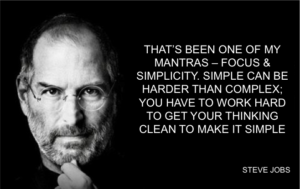
I am a fan of simple, fast read design. It’s hard to argue with the power of simplicity. As support, here are some words from the master of keep things simple.

“That’s been one of my mantras—focus and simplicity. Simple can be harder than complex. You have to work hard to get your thinking clean, to make it simple. But it’s worth it in the end, because once you get there, you can move mountains.” – Steve Jobs

Here is an example of an agency that not only preached simplicity; it used super clean and direct design to support its very own brand proposition.
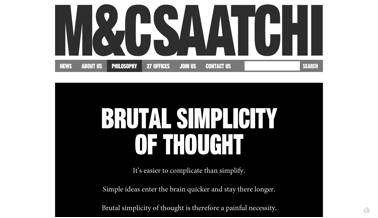
m&c sattchiSee how M&C Saatchi tells (well, once told) prospects what they will get from the agency as soon as the visitor hits the home page. M&C Saatchi delivers its message in about 1.5 seconds. Given the main message, could you imagine the agency having a complicated design to express this thought?

Maurice called the delivery of simplicity: One-Word Equity. This was their pitch from a few years ago. And, there can be no argument that his direct statement still works in today’s over-stimulated ADHD world.


OK, One More Uber Simple Website…
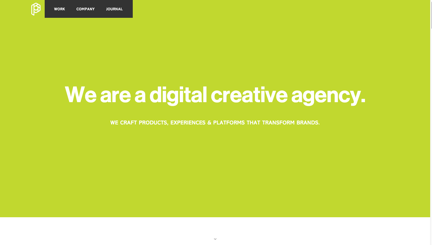
 playgroundJust to hammer the KISS point, I am including the home page of Playground. It took me 1 second to know what Playground is.

While I am not sure that saying “We are a digital creative agency” is a standout agency pitch, it is, without question, direct and therefore stronger than the front door of most agency websites.

What I Like: Website Elements

Once you have stopped the website visitor with your direct home page message (something compelling via copy or a video), you’ll have the time to tell them your agency story and supply key information.


Services

[Read more…] about The Best Advertising Agency Website

Interpersonal Chemistry and Body Language

Peter · August 4, 2017 · 1 Comment

Interpersonal Chemistry and Body Language and Sales

Body-Language-ChartMany pitches are won not because you are brilliant, but because the client simply likes you. I’ve sat on both sides of the advertising agency and client sales table and I can safely say, from my client side, that interpersonal chemistry is a critical factor in agency selection decision making.

Given the similarities of agency A to B to C to D (especially by the time an agency has made a client’s short list), interpersonal chemistry — the… “Hey, I like these guys” vibration will be the “all agencies sound the same” deal breaker. Actually, based on many of the interviews in my book on pitching (see above), chemistry is THE decision maker. If we agree that interpersonal chemistry is a critical component in agency selection, then we better get out our test tubes.

I believe that interpersonal chemistry can be managed. Your agency simply (OK, nothing is that simple), should think hard about a few elements of creating love. Here are some:

  • Study the client’s brand history and, especially, its and its category’s, marketing pain points. In the best of all possible worlds, you already did this to get into the meeting in the first place.
  • Get to learn who the individual clients are. You have a world of tools to ID and learn about each decision making client. This research on work and personal history, education, social media posts, etc. forms the back bone of your account based marketing program. I tell all of my clients that there is no such thing as a blind-date in 2017.
  • Ask for a pre pitch chemistry meeting. And, make this critical meeting work for you.
  • Back to the dating metaphor: remember the meeting is about them, not you. This may be one of the biggest mistakes an agency makes. The client needs to know how you will address their issues. Not, list ad nauseam the elements of your unrelated really cool Instagram program.

Body Language Is Critical

One experiment that you don’t want to run in the face-to-face meeting is how to manage, use, and read body language. This isn’t new territory for most agency people as we spend a fair amount of time trying to decipher our current client’s body language in strategy and creative meetings. It really is amazing to see the difference between a client that leans in and one that folds their arms, crosses their legs, and leans back.

Albert Mehrabian, the Professor Emeritus of Psychology at UCLA is well known for his study of verbal and non-verbal communication. According to Mehrabian’s 3 V’s of Communication, visual cues rule. Here’s his take on the relative value of three elements in face-to-face communication:

  • Verbal – words, content – 7%
  • Vocal – tone, pitch, intonation – 38%
  • Visual – body language, facial expression, gestures – 55%
  • Wow, content only gets 7%!?

I was a bit dumbfounded when I first saw this verbal, vocal, and visual breakdown. Is it possible that non-verbal communication is the essential ingredient of a successful presentation? Well no. And, that isn’t what Mr. Mehrabian is saying. Here is how a sage Wikipedian reports on Mehrabian’s conclusions.

“It is not the case that non-verbal elements in all senses convey the bulk of the message, even though this is how his conclusions are sometimes misinterpreted. For instance, when delivering a lecture or presentation, the textual content of the lecture is delivered entirely verbally, but the non-verbal cues are very important in conveying the speaker’s attitude towards what they are saying, notably their belief or conviction.”

Ah, the demonstration of “belief or conviction”.

This point is very important because we know that there can be an element of distrust in how some clients in the room might view an advertising agency presentation – “Oh, they will say anything to win the account; they are ad guys after all.”

I think that some of this client-think comes from the nature of our presenting the intangible magic of advertising (and, lately, the BS of digital marketing). A sense of disbelief is part of being on the buyer end of any somewhat subjective sales pitch. Therefore, we need to pay close attention to our non-verbal cues.

Playing to the intangibles of body language requires you to play two roles.

  1. The first is the role of observer. Is the client leaning in? Are they making eye contact or looking around the room or at their papers? How are they holding their arms (hopefully, not folded in front of them)? Are they fidgeting? Better, are they nodding in agreement, and are they taking notes?

Make sure that your team understands how to read the important positive and negative ‘tells’. Everyone should think like a poker player. If you need some extra stimulus on how to read the room, watch David Mamet’s great gambling movie House of Games.

2. Your other role is to be aware of your own body language, and make sure that your team is fully conscious of how they deliver their body language. Personally, I have always focused on my breathing, posture, and the position of my hands, head and eyes. I remind myself to go to an out-of-body view of how I might be perceived during the presentation. Self-awareness during the pitch is all-important.

We should want to look relaxed and stand straight. In this case, you also need to beware of looking too cool, or looking like the shifty poker players you see on TV who often want to demonstrate power by acting aloof. Rather, lean in like President Obama or Sean Hannity (hey, I am an equal opportunity viewer). Look like you believe in what you are saying and that you are confident.

Much of your conscious performance will be driven by your rehearsals which will make you familiar with your ideas, words, tone, pace, and body position. It is ok to critique your teammates during the rehearsal. Better that you point out a colleague’s wandering eye problem than have the client experience it later.

Tip:

Be very uber conscious of your surroundings.

Make sure that you actively read the room. Pay attention to your audience, listen closely to their comments for clues, and note their posture. Be prepared to make subtle adjustments to your presentation based on what you are seeing. I have been in pitches where I know that my colleague is failing by watching the audience’s reaction. In a worse case scenario, the speaker isn’t paying attention to his audience — he is just trying to deliver his lines and get though his section. Bad move for him and for you. All of your presenters must be aware of how they are being received and make adjustments. Have a set of visual codes to alert your colleagues about any body language fails. You might want to have your impartial pitch critic (I discuss this in my pitch book) act disinterested in your rehearsal just for practice.

Expedia And Sales Chutzpah

Peter · May 22, 2017 · Leave a Comment

A Lesson From Expedia On Sales Chutzpah

Screen Shot 2017-05-20 at 5.02.30 PMOK, we all have bad customer service experiences. I get it. But when the bad experiences go across four Expedia service phone conversations (that lasted about three plus hours over two days) and another six back and forth Twitter direct tweets and the customer who is spending over $5,000 on the trip is still unsatisfied (that’s me), there must be something wrong with how Expedia runs the humanbeing (vs. digital) sales service side of its business.

No, This Post Is Not About Expedia. It Is About Your Ad, PR, Digital, etc. Agency

Stick with me because this blog post is actually about a way to grow your agency – a way that requires a bit of chutzpah. However, before I get to your agency and an unignorable sales tactic, I have to share a tiny bit of customer service related background to set up the chutzpah recommendation.

A few weeks ago, I used Expedia to book two tickets from Mexico City to Budapest for a summer trip to see the Hungarian F1 Grand Prix race. This week, I called Expedia to change the trip by adding a few days up front and move the original first destination from Budapest to Vienna. I knew about and was willing to spend the extra $500 flight change charge and, before I called, I had also looked at all of the available flight options. I was prepared for the service rep call. But, I was not prepared for the following:

Expedia’s phone system could never recognize my itinerary number or phone number (the ones that are listed on Expedia’s original flight plan document). I knew I was in the system because when I finally got to a rep, she recognized the numbers. What’s up with Expedia’s automated phone system and the interface with its database?

While it took me about 30 seconds to get to the Iberia Airlines and Expedia sites to find my reservation detail, it took the multiple Expedia reps I talked to at around two minutes.

I was repeatedly asked if Mexico City was my origination airport (I live in Mexico) and if I was to change flights in Madrid as stated on my reservation. Um, yes.

The reps took forever to find alternative flights although I was helping them find the alternatives. And on. I won’t bore you with more including the third rep who apologized for how sloooooow Expedia’s computer was working.

Taken individually, these don’t appear to be too onerous. However, in aggregate, they were and I gave up without making the flight change.

OK, two more points.

I was so pissed off that I sent LinkedIn InMails to three Expedia marketing execs gently complaining about the service and asking them if they ever sat in on customer calls – consider this action an internal “Store-Check”. It’s been four days since I sent the emails. Any response? No. Sure these folks get lots of emails. But, I used attention-getting customer-centric subject lines.

[Read more…] about Expedia And Sales Chutzpah

The Cost Of Ad Agency Business Development

Peter · May 13, 2017 · Leave a Comment

Ad Agency Business Development. What Does It Actually Cost?Screen Shot 2017-05-13 at 9.53.38 AM

Simple answer? Ad agency business development costs… a lot. A more detailed answer follows.

I recently spoke about ad agency business development (essentially the art of Account Based Marketing) at Hanapin Marketing’s PPC Hero conference in L.A. and did a day long ‘how to pitch’ workshop for a major agency network at their annual meeting in Miami. I came away from both sessions thinking about the high cost of business development.

The True Cost Of Business Development

Since there is no one size fits all answer to what BD costs, I am going to illustrate the cost for a typical medium sized agency. Based on many conversations with agency leadership and the research done for my book on pitching (see the top of this page or just go here to buy it), the cost of participating in a serious pitch can cost close to $100,000. Sounds high, right? But, here is my math.

I am making the assumption that a typical medium size agency responds to 10 RFP’s and participates in 6 serious pitches per year. Of course, your mileage may vary.

RFP’s cost $15,000 to write and produce. This includes both hard and soft costs as in labor and overhead. At 10 RFP’s per year, that’s $150,000.

Pitches are more expensive.  Lets go with $35,000 per pitch. If you are an active agency, you’ll do 6 per year at a total cost of $210,000. FYI, I’ve run pitches at Saatchi & Saatchi that cost over $100,000. Not at all happy about that but that is a fact at the huge agencies pitching for huge pieces of business.

OK, back to the mid-size agency. The annual agency cost for RFP’s and pitching is $360,000.

But, there is more and I am going to be very conservative here. I am going with $200,00 per year for the cost of an active business development program itself. That’s the hard costs and the cost of a BD director and significant management time.

The total… $360,000 plus $200,000 = $560,000 or $56,000 per RFP and $93,333 per pitch.

Ouch.

Business Development – A Cost Center Or Opportunity?

The big question at many client companies is whether or not marketing is a cost or a business opportunity. Of course, you tell your clients that it is an opportunity that pays for itself. No marketing, no sales. Well, this is the case at many agencies. They simply do not spend the effort (as in time, investment and planning – oh, and execution) to run smart aggressive business development programs. As both an ex-Saatchi guy and small Oregon agency owner, I am blown away by this.

[Read more…] about The Cost Of Ad Agency Business Development

How Do Clients Choose An Advertising Agency?

Peter · May 3, 2017 · 1 Comment

How Do Clients Choose An Advertising Agency?

choiceAh, let me count the ways clients decide which advertising agency to contact when they need to dial up their marketing. But, let’s just keep this blog post real simple. They choose them based on what they do.

The “Data” Agency.

I am going to Miami next week to do an all-day workshop on business development pitching (plus agency sales in general and negotiating) for a large data marketing firm. While prepping for a discussion on how to sound unique, I took a look at how many of the top data oriented agencies talk about themselves. So, just to demonstrate what I call sameness vs. distinction, I offer their descriptions. These come from their websites. I’ve kept their names off to protect the innocent.

Note: I know that it is very difficult to find the words that deliver distinction when you need to start with a very clear definition of what you do. However, I think the following, at least, demonstrates that an advertising agency has to think hard about their words.

But, you know this. Therefore, this is just food for thought. I suggest that you take a hard look at your own descriptive words vs. your direct competitors. Since most clients are making a high percentage of their decisions about your agency before they ever call you (an understatement), this is a rather smart analysis that I recommend you do every six months given the speed of change.

The Agencies…

ABC. Make lifetime connections with the industry’s most advanced data-driven marketing.

DEF is a premier digital data analytics firm that works with the world’s leading brands to create, implement and action advanced analytics. 

GHI. We use data, technology, intuition and creativity to connect people to brands in a meaningful way.

JKL. We’re a data-driven marketing agency. We build individual relationships at scale using sophisticated data platforms and the same technologies that are disrupting the media environment.

MNO is a technology and services company that provides the data foundation for the world’s best marketers.

PQR is a global data-driven, technology-enabled performance-marketing agency.

STU is the leading global information services company, providing data and analytical tools to clients around the world.

  • « Go to Previous Page
  • Page 1
  • Interim pages omitted …
  • Page 29
  • Page 30
  • Page 31
  • Page 32
  • Page 33
  • Interim pages omitted …
  • Page 56
  • Go to Next Page »

Primary Sidebar

  • Featured
  • Resources
  • Podcast
  • The Big Advertising Agency Resource List
  • ChatGPT Loves Me. Does ChatGPT Love You?
  • How To Start, Grow and Sell An Advertising Agency
  • Which Social Media Strategy Is Best For Advertising Agency New Business?
  • How to Build A Winning Advertising Agency Business Development Program
  • A Faster Path To Become A Leading Advertising Agency
  • How To Move To Mexico
  • The Big Advertising Agency Resource List
  • What Is Your Elevator Pitch
  • Advertising Agency Process and Profitability
  • Check our ChatGpt FAQ Generator
  • Random Marketing And Advertising Resources
  • Bob Hoffman | The Ad Contrarian On Advertising Agency Presentations And Pitching
  • How To Be A Brilliant Podcast Guest
  • Want Advertising Agency New Business Leads? The Ratti Report Delivers
  • How To Manage A Brain On A Zoom Sales Meeting
  • YES! You Can Run A Powerful Zoom Meeting
  • How To Win A Mobile Dating App Client – On Zoom

Post Archive

Subscribe

Subscribe to the Advertising Stories Podcast

Apple PodcastsGoogle PodcastsSpotify

Contact

Email Peter
Connect on LinkedIn

Peter Levitan & Co.

Copyright © 2026 • All Rights Reserved • Peter Levitan & Co. • Log in